Teaser figure placeholder.
Export Figure 1 from the paper PDF and save it as static/images/teaser.png
(e.g. pdftoppm -png -r 220 -f 2 -l 2 ISO_arxiv.pdf, then crop the figure).
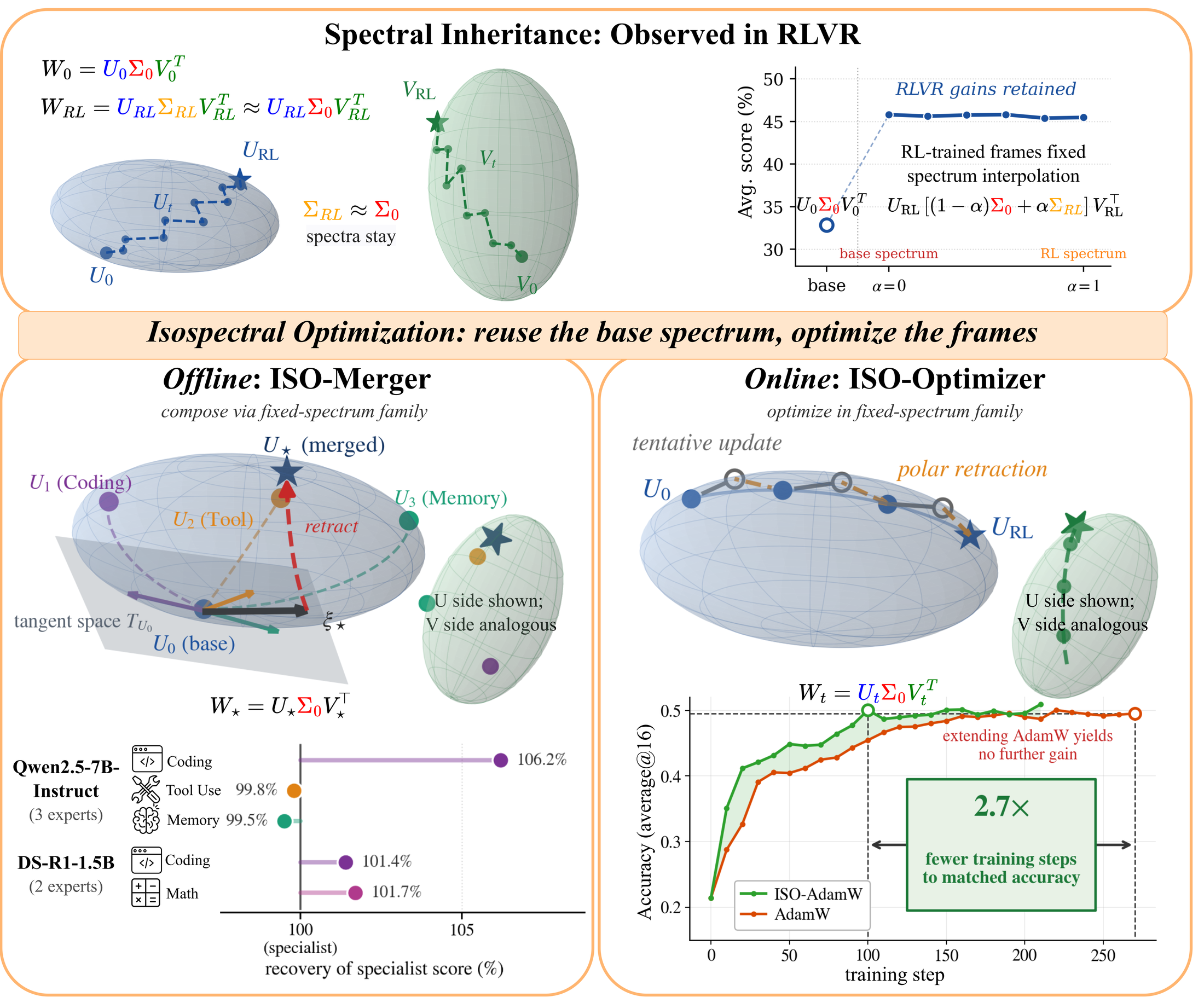
From spectral inheritance to Isospectral Optimization.
Unconstrained RLVR changes both singular frames while the weight spectra stay close to their base values — and restoring the base spectrum
Σ0 preserves most acquired gains.
ISO turns this regularity into an inductive bias: reuse Σ0, optimize
(U, V) — offline as ISO-Merger and online as ISO-Optimizer.
TL;DR
RLVR can reuse the base model's singular-value spectra while acquiring new capabilities by adapting the singular frames.
We verify this functionally (restoring the base spectrum preserves most acquired gains, and fixing it throughout training supports strong learning), and turn it into
ISO, a fixed-spectrum optimization stack: ISO-Merger composes shared-base RL experts with no data, rollouts, gradients, or distillation,
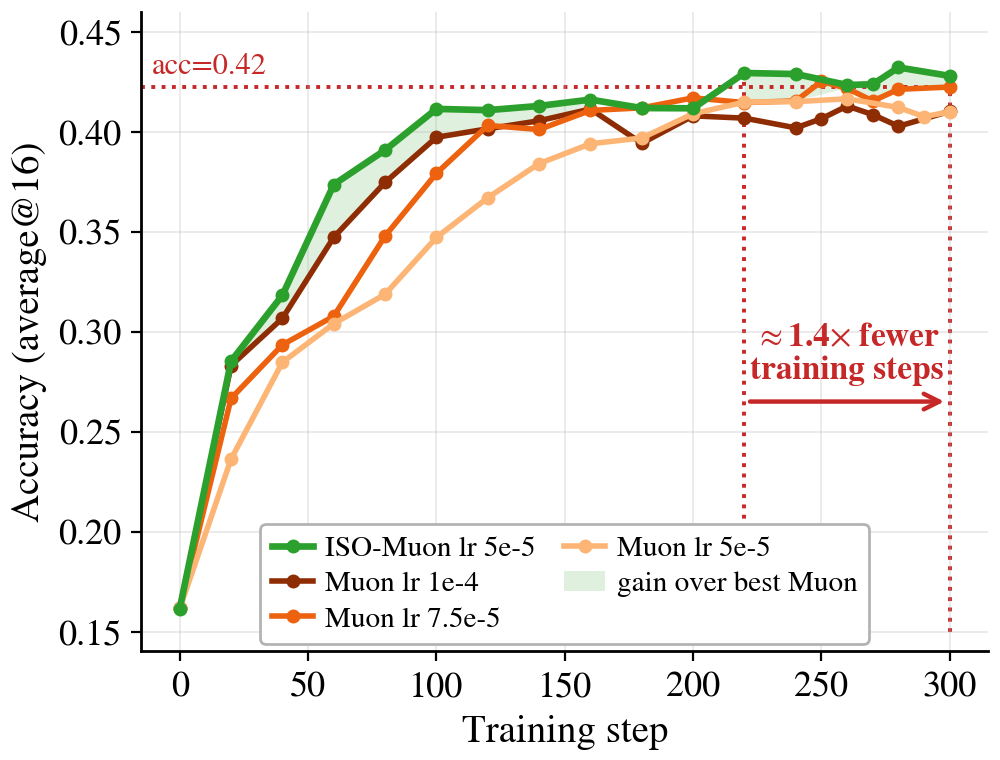
and ISO-Optimizer runs AdamW/Muon on the frames and reaches matched RLVR accuracy with 1.5× fewer actor updates on Qwen3-4B-Base.
Observation → Function
Spectra stay: spectral inheritance in RLVR
Write each weight matrix as W = U Σ V⊤:
the spectrum Σ sets the scale of each singular mode, the frames
(U, V) set its output/input directions.
Across RLVR runs — including a public reasoning run trained for 3,000+ updates — the learned checkpoint sits strikingly close to the
fixed-spectrum family of its base weights: the pooled spectral residual is approximately 3% of the total base-to-RL weight displacement.
In the sequential SFT and RLVR comparison, the mean relative residuals are approximately 32% and 2%, respectively.
These transitions start from different checkpoints; the SFT endpoint is the RLVR base.
Dimension-normalized spectrum-changing energy remains order-one relative to an isotropic reference for RLVR,
so proximity alone does not establish a strong preference for spectrum-preserving updates. We test spectral reuse functionally:
restore the base spectrum after training, or never let it move at all.
Takeaway 1 — Spectral inheritance.
RLVR can reuse the base model's weight spectra rather than rewrite them:
restoring the base spectrum in the RL-trained frames preserves most acquired gains, and training with the spectrum
frozen from step one still learns strongly. These interventions support reusing the base spectrum while adapting the frames.
The rebase experiment, interactive
Take an RLVR checkpoint (DeepSeek-R1-Distill-Qwen-1.5B → Nemotron-Research-Reasoning-Qwen-1.5B),
keep its learned frames(URL, VRL) fixed, and interpolate only the spectrum
between the base model's Σ0 and the RL-trained ΣRL.
At α = 0 the RL model's spectrum is fully replaced by the base spectrum.
Drag the slider to inspect the relatively small changes in accuracy:
Spectrum interpolation with RL-trained frames fixed
Each of the six slider stops is a separately evaluated model. This panel shows the five math benchmarks; the paper also reports two coding metrics. Only the singular values change; the frames remain fixed.
W̃(α) = URL
[ 1.00 · Σ0
+
0.00 · ΣRL ]
VRL⊤
α = 0.0
α = 0 · base spectrum Σ0 restoredα = 1 · original RL checkpoint
Average score at current α
–
Base model (pre-RL)
37.6
average over the 5 math benchmarks
Δ vs. full RL checkpoint
–
Small aggregate differences across the evaluated α values
score of W̃(α) — RL frames, interpolated spectrum base model before RLVR
Show the evaluated anchor data (Fig. 4a)
Benchmark
Base
α=0.0
α=0.2
α=0.4
α=0.6
α=0.8
α=1.0 (RL)
Restoring the base spectrum preserves most acquired RLVR gains.
A spectrum-only parameterization (frames frozen, singular values trainable) likewise fails to learn comparably —
what RLVR needs to change is the frames.
The mirror test: graft the RL spectrum into the SFT frames
Run the same interpolation in the opposite direction: fix the frames of the SFT model(USFT, VSFT) and blend the spectrum toward the RL-trained
ΣRL. If RLVR's gains lived in the spectrum, scores should climb toward the RL
checkpoint as α grows. Scores remain nearly unchanged:
Spectrum interpolation with SFT frames fixed (mirror control)
Each of the six slider stops is a separately evaluated model. The dashed marks show the full RL checkpoint — the bars never approach them.
W̃(α) = USFT
[ 1.0 · ΣSFT
+
0.0 · ΣRL ]
VSFT⊤
α = 0.0
α = 0 · original SFT modelα = 1 · SFT frames + full RL spectrum
Average score at current α
–
Full RL checkpoint
46.0
average over the same 7 benchmarks
Δ vs. RL checkpoint
–
The RL spectrum alone does not yield comparable gains
score of W̃(α) — SFT frames, interpolated spectrum full RL checkpoint (Nemotron, ~3k RLVR updates)
Show the evaluated anchor data
Benchmark
RL ckpt
α=0.0
α=0.2
α=0.4
α=0.6
α=0.8
α=1.0
Substituting the RL spectrum into SFT frames does not yield comparable gains.
Across the evaluated interpolation coefficients, the seven metrics remain near the SFT model's performance,
with an observed range of approximately 3.2 percentage points or less per metric.
Together with spectrum restoration in RL-trained frames, this supports the functional reusability of the base spectrum.
Structure
Frames move — and both must stay adaptable
If the spectrum can be inherited, which variables must remain free? We reconstruct RL endpoints under four structural restrictions
and measure how much of the checkpoint update each one fails to explain
(two-stage VLA RL pipeline, transition W0 → W2, median across layers):
Remix within both incoming subspaces (umix)87%
Freeze output subspace only (uL)45%
Freeze input subspace only (uR)42%
Fix the spectrum, adapt both frames (uiso)1.8%
Fraction of the checkpoint update left unexplained by the best reconstruction in each class (lower is better; 100% = no change explained). The same pattern recurs across sequential RL stages with distinct objectives.
Takeaway 2 — Fix the spectrum, keep both frames adaptable.
Even permissive remixing inside the incoming subspaces, or freezing just one side, leaves a large share of the update unexplained.
Retaining the incoming spectrum while adapting both frames leaves only ~2% — directly motivating ISO's parameterization
W(U,V) = U Σ0 V⊤.
Method
ISO: Isospectral Optimization
Inherit the spectrum, optimize the frames:W(U, V) = U Σ0 V⊤,
U, V on the Stiefel manifold.
U — output frame · moves
×
σ1σ2⋱σq
Σ0 — base spectrum · frozen
×
V⊤ — input frame · moves
The base optimizer receives ambient factor gradients and takes a
tentative frame update that need not lie in the tangent plane.
Polar restoration restores orthonormal frames, so
Wt = Ut Σ0 Vt⊤
retains the base spectrum in exact arithmetic. The ellipsoids and update paths are schematic; the gray planes show local tangent geometry.
Every represented matrix shares the base spectrum Σ0 exactly; all learning and composition happen in the frame
coordinates, with a polar retraction restoring orthonormality. ISO is a stack, not a single optimizer — one principle, two instantiations
spanning the RLVR workflow:
Offline
ISO-Merger — compose RL experts without rollouts
Take specialists trained from a shared base, express each expert as a displacement of the singular frames
(project → mask trailing modes → solve unit-retention coefficients → retract), and rebuild one fixed-spectrum model.
No post-merge data, rollouts, gradient updates, or on-policy distillation.
Online
ISO-Optimizer — fixed-spectrum RLVR training
Apply your existing optimizer — AdamW or Muon, states and all — to (U, V) instead of
W, keep Σ0 frozen, and retract after each step —
a strictly more constrained model class.
Fewer training steps, higher rewards.
Results · Offline
ISO-Merger: data-free expert composition
Merging RLVR specialists in fixed-spectrum frame coordinates recovers their complementary capabilities — without post-merge training, rollouts, or distillation.
Recovery of each specialist's own score by the single merged model:
Qwen2.5-7B-Instruct — 3 RL experts
Coding106.2%
Tool use99.8%
Memory99.5%
DeepSeek-R1-Distill-Qwen-1.5B — 2 RL experts
Coding101.4%
Math101.7%
Recovery of specialist score (%); the vertical mark is 100% = the original specialist itself.
Means over 3 independent stochastic evaluation runs (standard deviations in the paper). Expert rows shaded blue; bold marks the best expert and the best merged result per column.
DeepSeek-R1-Distill-Qwen-1.5B · coding + math experts
Method
LiveBench
LCB v5
AIME24
AIME25
AMC23
Minerva
Olympiad
Avg
ACC
UT
ACC
UT
@32
@32
@8
@4
@4
Base (DS-R1-Distill-1.5B)
17.99
26.24
16.82
20.85
30.90
23.40
63.15
27.33
43.11
29.98
Archer2.0 (coding)
26.66
37.26
26.90
38.99
42.05
28.02
73.44
30.09
49.99
39.27
JustRL (math)
22.23
31.85
23.05
30.18
53.16
36.84
82.78
34.71
55.67
41.16
Task Arithmetic
26.22
35.82
26.70
36.58
50.83
33.09
80.82
33.00
54.31
41.93
TIES
26.37
36.75
27.62
39.45
54.51
35.76
82.13
33.76
55.36
43.52
TSV
26.40
36.83
27.61
40.01
53.16
35.17
80.97
33.88
54.68
43.19
RAM
26.71
36.99
27.18
38.83
54.20
35.80
82.28
34.10
55.54
43.51
OrthoMerge-G-TIES
26.46
36.73
27.74
39.86
54.55
35.14
81.88
33.55
55.47
43.49
ISO-Merger (ours)
25.52
36.42
27.84
41.84
55.00
37.81
83.53
34.77
56.64
44.38
ISO-Merger achieves the strongest aggregate performance among the compared data-free merging methods on both backbones, and improves worst@4 by 1.62 / 1.36 points — more consistent capability recovery, not just a better mean.
Results · Online
ISO-Optimizer: same reward signal, fewer steps, higher accuracy
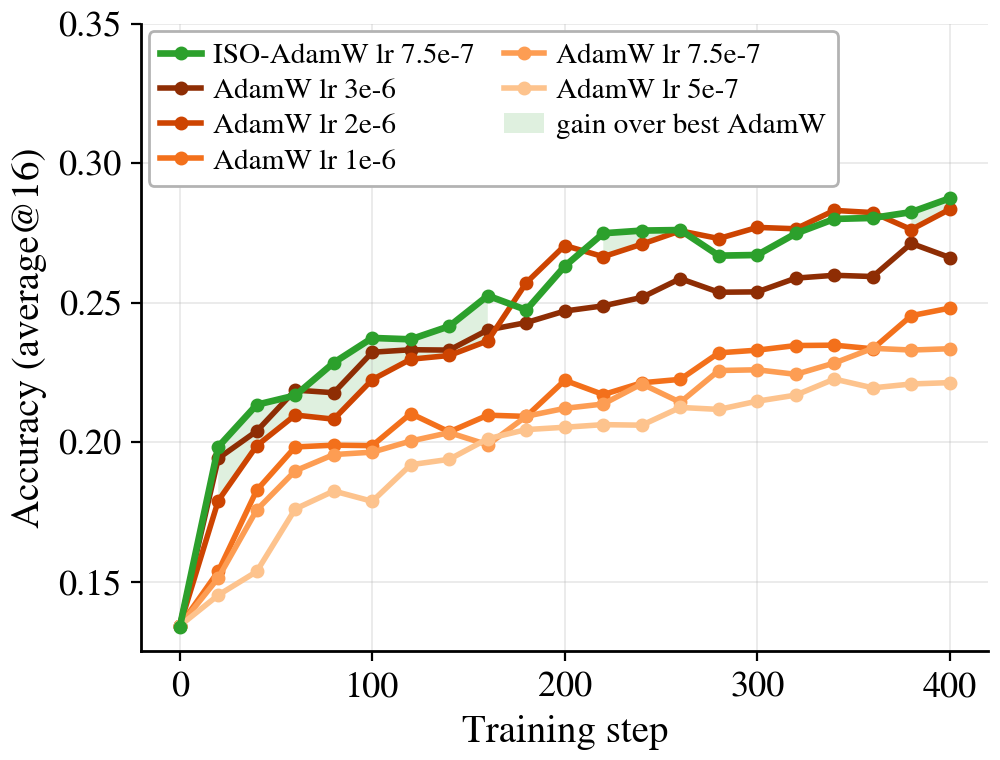
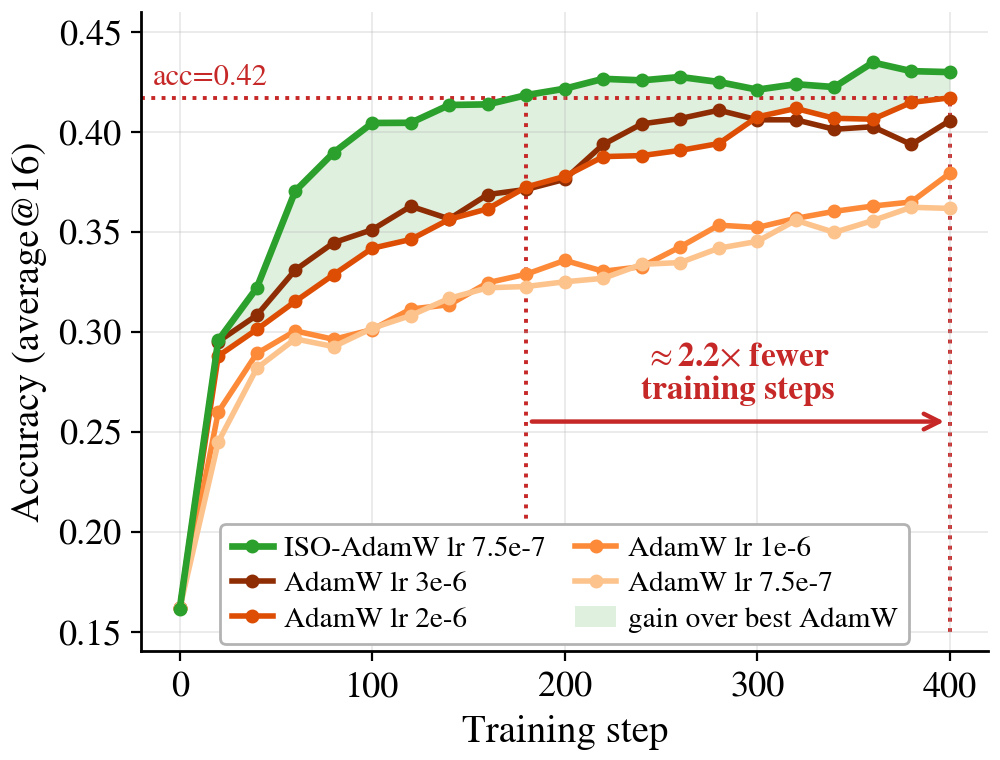
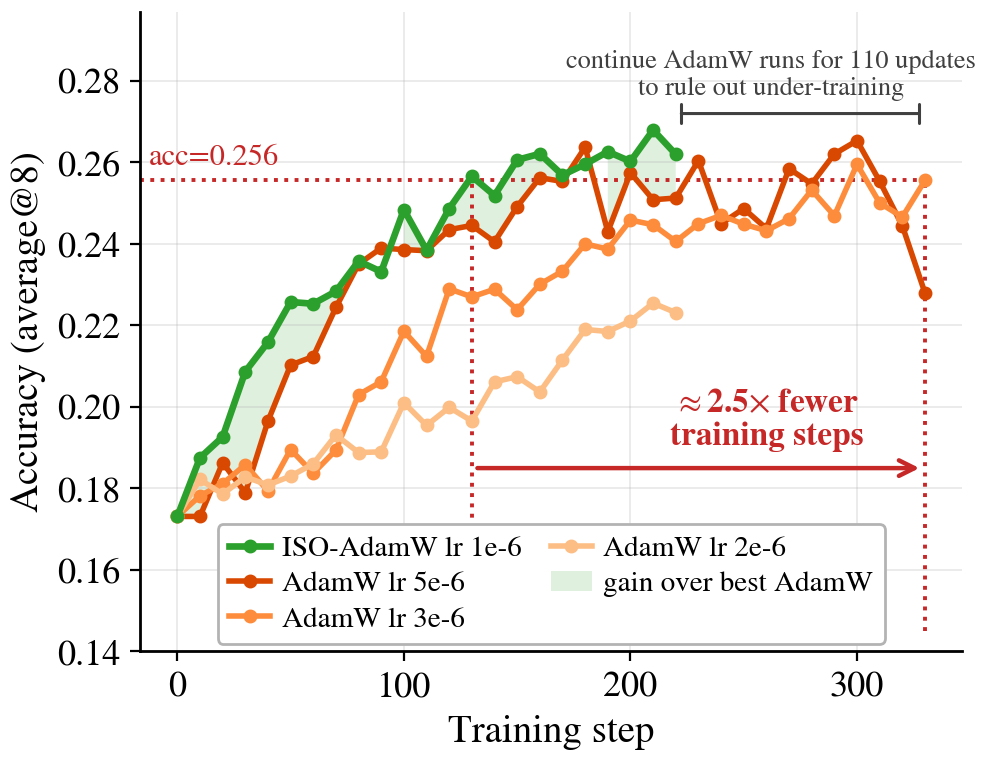
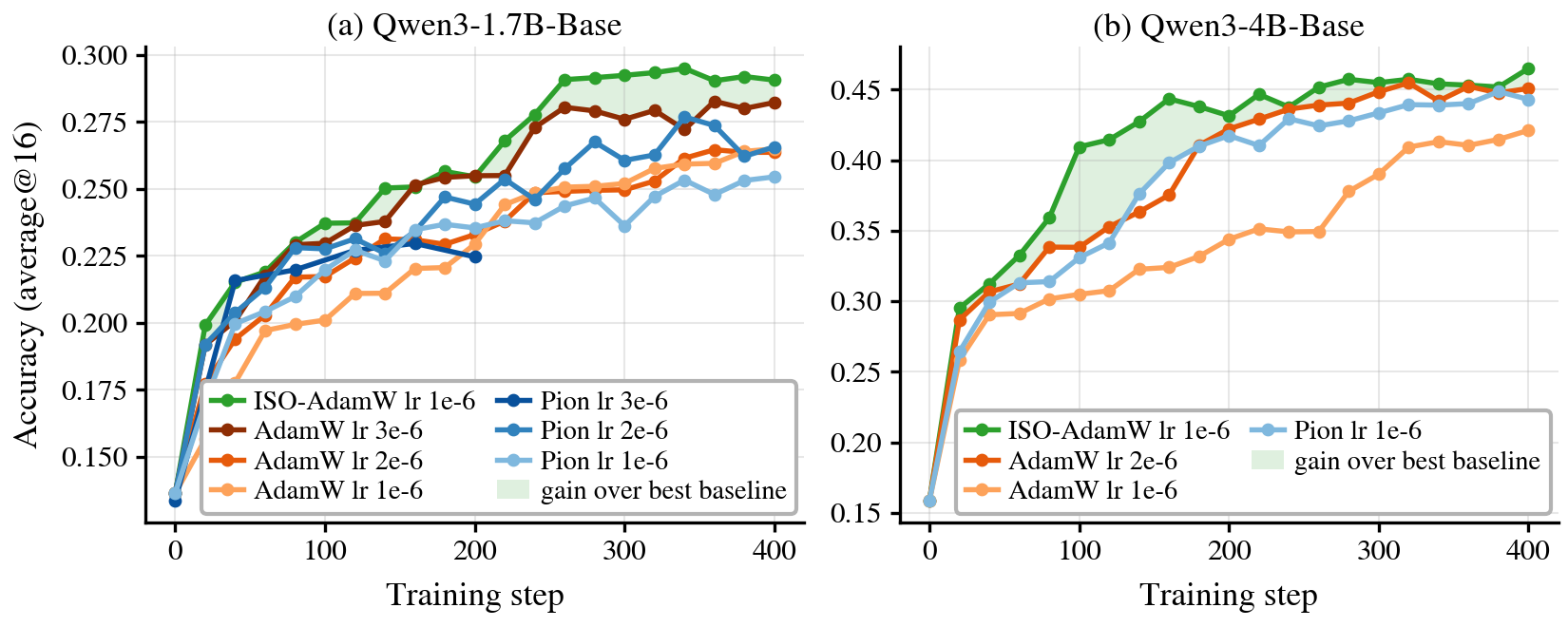
ISO-AdamW uses a frame learning rate of 1×10⁻⁶ at both math scales,
while AdamW and Muon baselines are tuned over learning-rate sweeps. At 400 actor updates,
ISO-AdamW achieves 29.41 on Qwen3-1.7B-Base and 46.98 on Qwen3-4B-Base —
improvements of 1.21 and 2.16 points over the strongest tested AdamW baselines.
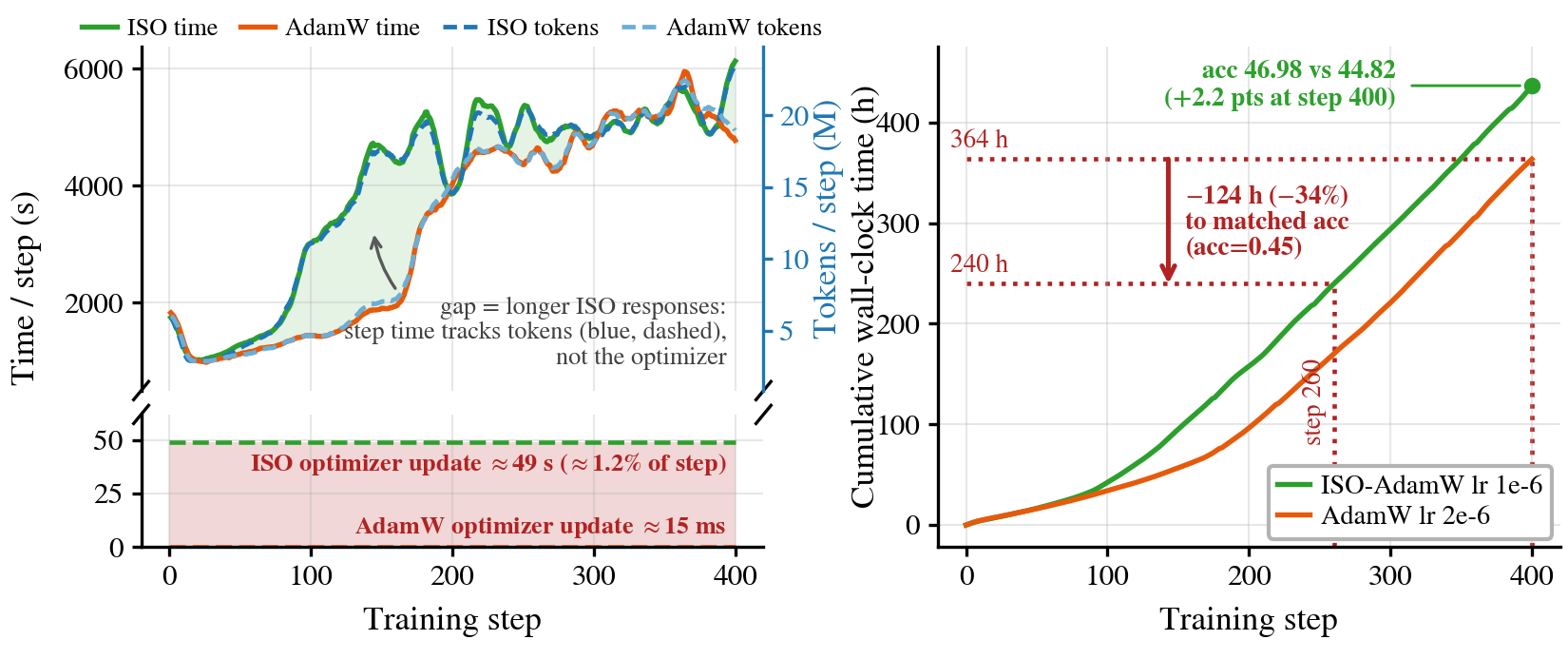
Qwen3-4B-Base, DeepMath-103K. ISO-AdamW reaches AdamW's 400-update accuracy at update 260,
saving 124 hours (34%), and finishes 2.16 points higher at update 400.
Additional optimizer computation is about 49 seconds per step (1.2%) of the profiled end-to-end step time.
Qwen3-1.7B-Base — highest final aggregate accuracy vs. the full AdamW sweep.
Qwen3-4B-Base — matches AdamW’s 400-update accuracy at update 260, then keeps improving.
ISO-Muon — matches the strongest Muon run’s 400-update accuracy at update 300; final scores are 46.2 vs. 45.5.
Coding (DS-1.5B, ArcherCodeR) — scores 25.58 vs. 24.80 at 200 updates; AdamW runs extended to 260 updates do not match ISO-AdamW’s peak of 25.7.
Math RLVR (average@16, DeepMath-103K)
Model
Method
AIME24
AIME25
AMC23
Minerva
Olympiad
Avg
Qwen3-1.7B-Base
Base
3.33
2.50
23.34
18.43
19.19
13.36
AdamW
14.38
10.21
44.58
33.02
38.80
28.20
Muon
15.22
11.26
45.51
32.96
40.09
29.01
ISO-AdamW (ours)
16.67
11.67
44.50
33.92
40.30
29.41
Qwen3-4B-Base
Base
5.00
3.96
26.58
20.43
21.95
15.58
AdamW
32.92
22.08
67.77
45.29
56.02
44.82
Muon
32.29
25.00
66.34
46.12
57.82
45.51
ISO-AdamW (ours)
33.54
28.13
68.60
46.97
57.64
46.98
Final checkpoint at actor update 400. ISO-AdamW uses a frame learning rate of 10−6. AdamW is swept over {0.75, 1, 2, 3}×10−6, plus 5×10⁻⁶ on 4B; Muon over {2.5, 5, 7.5}×10−5.
Competitive coding (average@8, LiveCodeBench, 200 actor updates)
Method
LCB v5
LCB v6
Avg
DS-R1-Distill-1.5B
16.31
18.32
17.31
AdamW
24.60
25.00
24.80
ISO-AdamW (ours)
24.64
26.53
25.58
ISO-AdamW uses a frame learning rate of 1.5×10⁻⁶ for coding; AdamW is swept over {1, 2, 3, 5}×10−6. The main comparison uses 200 actor updates to limit multi-epoching on the smaller coding dataset.
Comparison with Pion
Pion is a concurrent spectrum-preserving optimizer with its own momentum and step-size rules.
ISO applies a chosen base optimizer directly to both singular frames.
Among completed 400-update runs, ISO-AdamW achieves the highest final accuracy at both scales;
Pion outperforms AdamW at 10−6 but not the strongest tested AdamW configuration.
Qwen3-1.7B-Base (left) and Qwen3-4B-Base (right).
On 4B, ISO-AdamW reaches Pion's 400-update accuracy using approximately 40% as many actor updates.
Pion uses its official implementation. Learning rates are swept over {1, 2, 3}×10−6 on 1.7B;
the 3×10⁻⁶ run is stopped early after accuracy starts declining at update 160.
On 4B, computational constraints limit Pion to its published RLVR learning rate of 10−6, without further tuning.
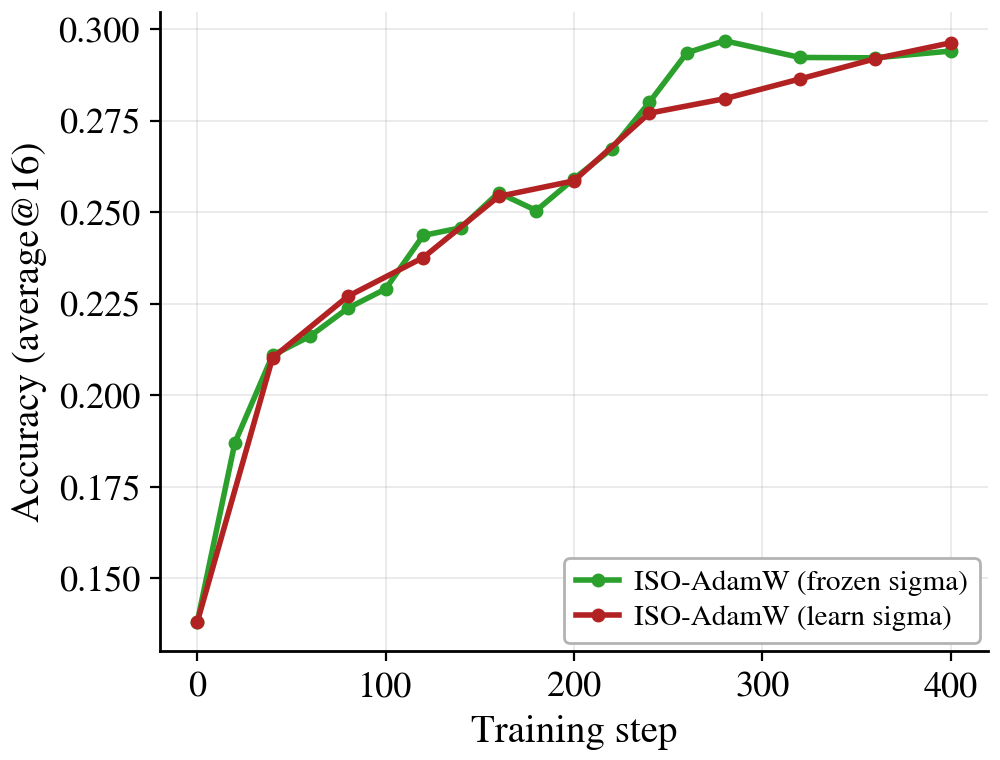
Ablation: does learning the spectrum help?
We compare ISO-AdamW with a variant that also trains the diagonal spectrum
Σ, initialized at Σ0,
while retaining the same factorization and orthonormal frame constraints.
On Qwen3-1.7B-Base, fixed and trainable spectra yield similar learning trajectories.
Fixed vs. trainable spectrum. At update 400, aggregate accuracy is 29.4 vs. 29.6, respectively.
The learned spectrum's relative drift is only 0.0065%.
Comparable observed accuracy supports reusing the base spectrum.
Reference
Citation
@article{zhu2026iso,
  title         = {ISO: An RLVR-Native Optimization Stack},
  author        = {Zhu, Hanqing and Cong, Wenyan and Sha, Zhizhou and Mukherjee, Sagnik and
                   Song, Xinyuan and Gonz{\'a}lez-Mart{\'i}nez, David and Wu, Xiaoxia and
                   Tian, Yuandong and Liu, Shiwei and Pan, David Z. and Wang, Zhangyang},
  journal       = {arXiv preprint arXiv:2607.19331},
  year          = {2026},
  eprint        = {2607.19331},
  archivePrefix = {arXiv},
  primaryClass  = {cs.LG},
  url           = {https://arxiv.org/abs/2607.19331}
}
 ISO: An RLVR-Native Optimization Stack